
Basic statics and external correction with lingualized occlusion (according to Prof. Dr. Gerber)
The upper and lower rows of teeth must be aligned. During the model analysis, it must already be considered whether a canine-premolar guidance with lingualized occlusion or a balanced occlusion is to be realized. As a general rule, the teeth must not be positioned too far buccally or orally so that the patient does not bite down on the cheek or tongue and the chewing forces can be absorbed according to the direction of pull of the masticatory muscles.
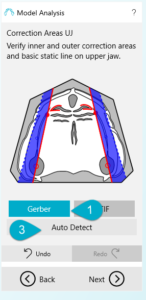
The set-ups in the Baltic Denture system correspond to the occlusion concept of canine-premolar guidance with lingulized occlusion without grinding in the movement paths.
If this concept is desired, you can continue with the definition of the installation corridors by selecting “Gerber” (1) (recommended).
The palatal cusps of the second upper premolars and upper molars find centric contacts in the central pits of their respective antagonists.
The buccal cusps are not in contact with each other.
The model analysis based on this setup concept is limited to the definition of the corridors between the basic statics (red line – figure below) (1) and the outer bony boundary of the alveolar process of the maxilla in the posterior region (blue line – figure below) (2).
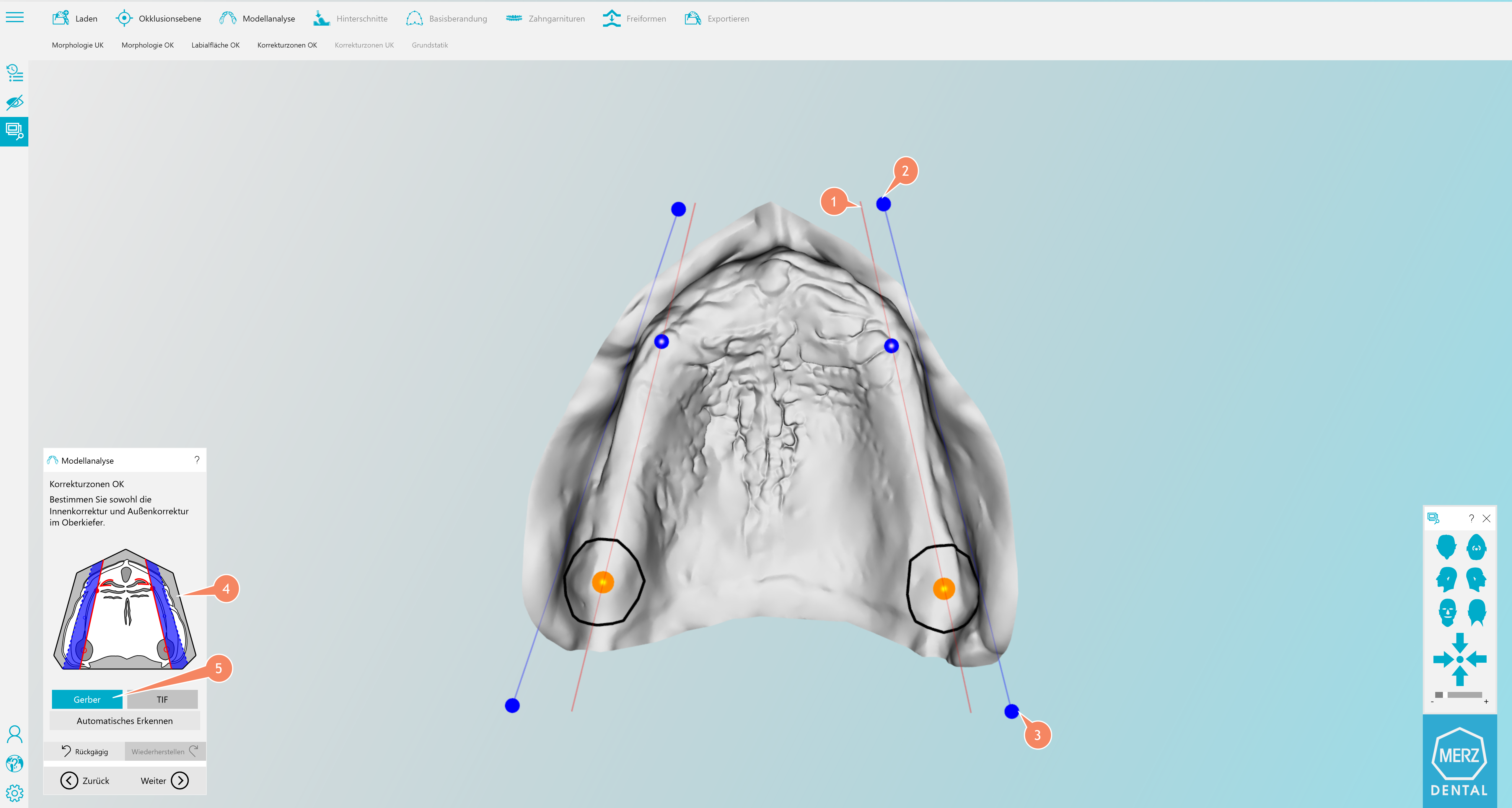
As the upper jaw is the jaw with the narrower dental arch in relation to the lower jaw due to atrophy after tooth loss, the analysis of the upper jaw is decisive for the selection of the appropriate row of teeth. The basic statics (1) is a line that runs through the position of the first upper premolars and the center of the tuber maxillae (maxillary tuberosities). This line is defined by the positioning of the anatomical landmarks in the previous step “Anatomical markings on the upper jaw” and can no longer be influenced in this step.

External correction of upper jaw blue line (2). The contacts of the working cusps of the upper posterior teeth must not exceed the corridors (1) delimited by a blue line (area) (for clarification, the basic statics have been hidden in the illustration).
It offers the greatest vestibular freedom and is therefore a preferred variant of model analysis in terms of chewing function, tongue freedom and cheek support.
All contact between the rows of teeth beyond the corridors must be avoided. The software warns of a “violation” of the external correction in the “Tooth sets” step by coloring the selected row of teeth red.